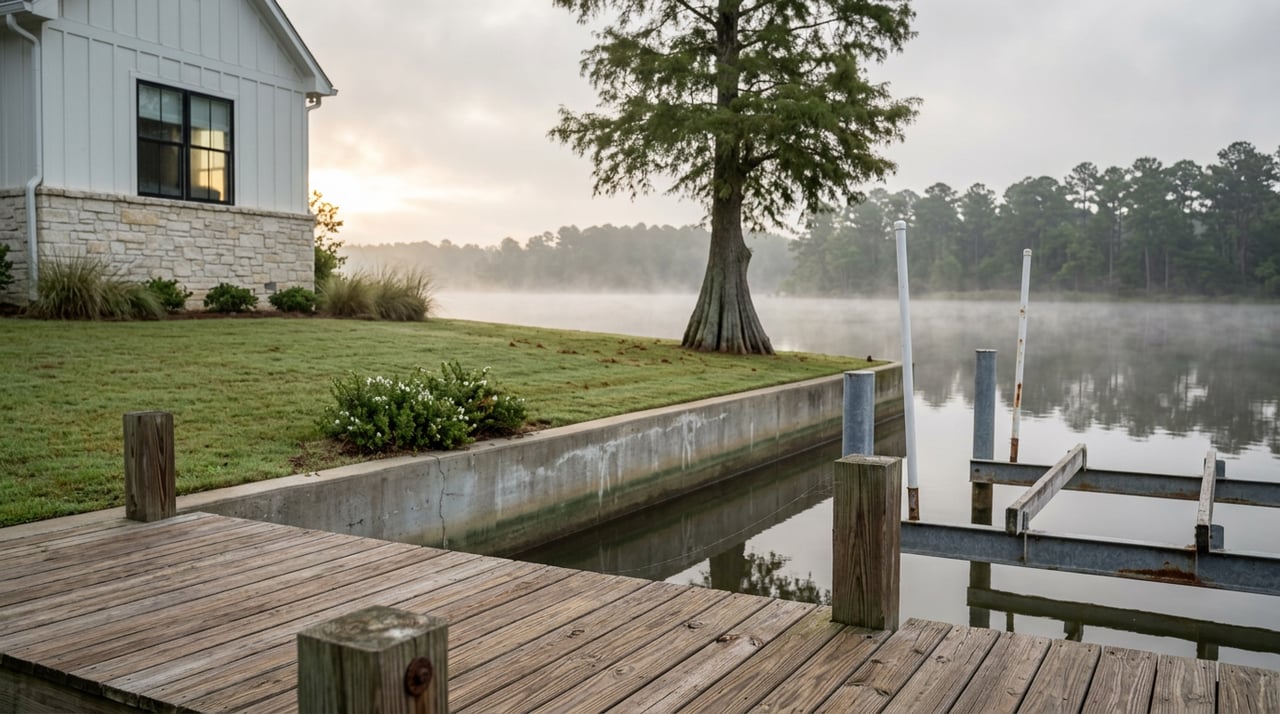
Ask a Lake Conroe seller if the dock comes with the house, and most will say yes without hesitating. Ask the San Jacinto River Authority the same question, and the answer gets more complicated. The dock, the boat lift, and the bulkhead sitting in the listing photos are not automatically part of what changes hands at closing. They are separately licensed structures, and the license belongs to a government agency that can revoke it at any time.
For buyers weighing waterfront property near Montgomery, in communities like Walden, Bentwater, and April Sound, this distinction is not a technicality. It is the difference between buying a functioning boating lifestyle and buying a house with an expensive problem attached to the shoreline.
The Permit Is a License, Not a Deed
The San Jacinto River Authority's Lake Conroe Division regulates every private dock, boat slip, and bulkhead on the reservoir. Its own licensing rules put it plainly: "no person shall construct, operate or maintain a Private Structure on Lake Conroe at any time without a proper permit or license." That permit carries an annual fee based on the size and location of the structure, and SJRA can revoke it at any time and for any reason it deems necessary.
That last point matters more than most buyers realize. The right to keep a dock is not something that comes bundled with waterfront ownership. It is granted, and it can be taken back. SJRA is also under no obligation to maintain any particular lake level to keep a private structure usable, which means a dock built for one set of water conditions can become a liability under another.
None of this means Lake Conroe docks are risky to own. Thousands of them operate under valid, current permits every year. It means the paperwork behind the structure is worth confirming independently, not accepted on the seller's word.
Why Two Nearly Identical Docks Can Carry Different Price Tags
Two waterfront homes can look the same in photographs and sell for very different prices, and the gap often traces back to what is actually documented. A home with a current SJRA permit, a bulkhead in good repair, and a permit that transfers cleanly at sale is a different asset than a home with the same view and an undocumented structure. The second buyer inherits the first owner's paperwork problem along with the shoreline.
This shows up most clearly in canal communities like Cape Conroe, where lots look similar from the street but carry real differences in water depth, dredging history, and permit status once you get to the shoreline. Canal frontage protects boats from wind and wake better than open water, but it often means shallower depth and tighter maneuvering, and the permit history behind any dredging matters more than the neighborhood name on the sign.
Bulkheads add another layer. Depending on material and condition, a bulkhead can last anywhere from 15 to 40 years, and freshwater is gentler on most materials than saltwater, but Lake Conroe's water level swings still put stress on aging walls. Replacing or stabilizing a shoreline can run from the low tens of thousands of dollars for a short section to well over $100,000 for a longer, engineered run. That is not a cost most buyers price into an offer unless someone tells them to look for it.
The Lake Doesn't Run on the Old Rules Anymore
Longtime Lake Conroe residents sometimes describe a seasonal pattern from years ago that no longer applies the same way. Before Hurricane Harvey, SJRA managed lake levels through a program built around predictable seasonal lowering. During the 2017 storm, the reservoir released water at a peak rate of nearly 80,000 cubic feet per second, according to Hello Woodlands, and the flooding downstream reshaped how the agency thinks about storm capacity.
SJRA now operates under what it calls Active Storm Management. From April 1 through June 1, the City of Houston, which holds rights to roughly two-thirds of the reservoir's water, can request diversions to lower the lake from its 201-foot normal pool down to as low as 200.5 feet, creating storage room ahead of forecast rain. A drought contingency plan triggers watering restrictions if the level falls to 199 feet.
As of today, August 5, 2026, Water Data for Texas shows Lake Conroe at 98.2 percent full, sitting close to that 201-foot benchmark. A USGS gauge reading from mid-July put the elevation at 201.25 feet. That means anyone inspecting a dock or bulkhead right now is seeing it under close-to-normal operating conditions, not during a drought drawdown or a post-storm high, which matters if you're scheduling an inspection this month.
What to Verify Before the Option Period Ends
A few items belong on every Lake Conroe due diligence list, and none of them are things a title company checks automatically.
- Permit number and transfer status. Ask SJRA directly whether a permit exists for the dock, lift, and bulkhead, and whether it transfers with the sale or requires the new owner to reapply under current rules. A reapplication puts a buyer in front of whatever standards are in effect today, which may be stricter than the ones the original structure was approved under.
- Septic and on-site sewage status, if applicable. SJRA regulates on-site sewage facilities near the reservoir, and a system that has never been inspected or permitted becomes the buyer's problem the day the sale closes.
- Bulkhead age and material. Ask when it was built, what it is made of, and whether there is any record of repair or movement. Freshwater is forgiving, but decades of water-level swings are not nothing.
- Corps of Engineers involvement. Any work touching the lakebed or shoreline, including bulkhead replacement or dredging, can require review from the U.S. Army Corps of Engineers Galveston District in addition to SJRA.
- HOA or architectural review layered on top. Communities like Walden, Bentwater, and April Sound often add their own design rules for docks and shoreline structures, which can be stricter than SJRA's minimums. Ask for the current guidelines, not last year's.
Bring these questions into the option period, not after closing. SJRA's review timeline for new or modified structures is not instant, and a buyer who discovers a permit problem after the deal is signed has far less leverage than one who found it during inspection.
Straight Answers Before You Write an Offer
Does an SJRA permit transfer automatically when a property sells? Sometimes, and sometimes not. Some structures transfer with notice to SJRA. Others require the new owner to submit updated documentation or a fresh application. The only way to know is to ask SJRA directly about the specific property.
What if the seller can't produce a permit at all? That is a contract conversation, not necessarily a deal breaker. It might mean the structure predates current permitting and could still be documented, or it might mean the dock was never authorized and needs to be brought into compliance or removed. Either way, it belongs in the negotiation, not a surprise discovered after closing.
Does this apply to canal lots the same way it applies to open water? Yes. SJRA regulates structures anywhere they touch the water, shoreline, or lakebed, whether the lot faces open water or sits on a canal in a community like Cape Conroe. Canal frontage changes the boating experience, not the permitting requirement.
Is a full lake level always a good sign for inspections? It is a useful inspection condition, since docks and bulkheads perform closer to their normal operating range. It says nothing about whether the underlying permit is valid, current, or transferable, which is a separate question worth asking regardless of what the gauge reads that week.
Waterfront property near Montgomery rewards buyers and sellers who do this homework early, and it can be unforgiving to those who skip it. If you are weighing a purchase on Lake Conroe, or preparing to list a waterfront home and want the permit file in order before it goes on the market, Jenny Hill can walk through the specific documentation your property needs and help you build the right questions into your offer or your listing strategy. Schedule a Consultation to start that conversation before your option period is running out the clock.